|
I always waited for the accidents to stop. The first one to die was Ulli,
then came Rolf and his wife Senta, then Klaus, then Harald, .... But somehow
it never stopped. And always I thought that this is part of the game,
and that I will learn from the mistakes the others had made. We thought
like Thomas Friedman, the renowned journalist from the New York Times
who lived in Beirut during the Lebanese civil war: When one of his friends
got killed by a bullet 5 minutes after one of the many ceasfire pauses
had started, they thought: "Of course you get killed when you venture
out only 5 minutes after the ceasfire!" Similarly I thought: "Of
course you don't go ski-touring alone!" - after one of my acquaintances
got killed by an avalance. Or "Of course you always have to climb
with a rope!", after Klaus fell to his death on the decent, climbing
down a relatively easy section without a rope.
Robert |
My Accident |
I really miss Robert. Funny, though, as I had not seen him much
in the years and months before his accident.
The last time we climbed together was a magical day in the Wetterstein.
After the climb we sat in the warm sun, wondering why we still liked
the mointains so much.
The last time I saw Robert, I was already a partial paraplegic.When
I told him that I felt stupid, having had an accident, having made
"a mistake", he told me about his recent close calls.
An avalanche that did not bury them; a slip in the Karwendel, which
he managed to stop just before the big drop; the end of the rope,
that he noticed 1m before he went over it - 100m above the ground.
Everyone makes mistakes. Sometimes you get away with them - sometimes
you don't.
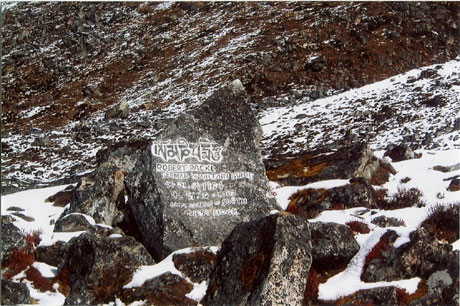
Robert did not get away with it on Ama Dablam, when he slipped
while walking back to help a Sherpa carrying up his load. The rope
with which he tried to stop his fall snapped. He fell about 100m,
30 of them over a rock cliff. He died there of his injuries.
Robert, I fucking miss you. We met at Joshua Tree, 100 miles outside
Los Angeles. The night before we left Joshua Tree, after we had
finished the huge barbeque steaks, we decided to climb "Walk
on the Wild Side" after midnight. I remember the outline of
you and the rock against the stars, you gradually vanishing into
the sky. At the top, sitting on a ledge above a moon-lit desert,
you pulled two cans of beer out of your backpack, and we talked
about what we wanted from life. We wanted to live intensely, we
did not care too much about getting old. You were the one who followed
the mountains, I tried to make a compromise between them and the
"real world". I am afraid neither of us really found what
he wanted. But where did we go wrong? I am still wondering, almost
every day.
|
Ironically, after climbing in the mountains for
17 years, my accident happened in a climbing gymn. I have described
the events in the Article "Denn
erstens kommt es anders, ..." in the magazine Berg&Steigen
(in German) On April 25 2001, over lunch in a climbing gymn, Sarah
missunderstood me, and - instead of lowering me - she disengaged
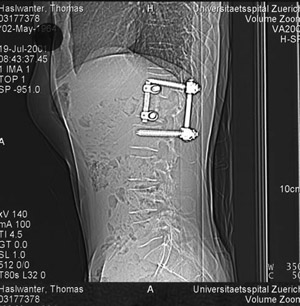
the rope. I fell 12 m, backward. The impact shattered my top lumbar
vertrebra, compressing my spinal cord. They got me into hospital
fairly quickly. Jean, my wife, was told I'd be in a wheelchair.
I wasn't - but only by 1 mm of nerve fibers, which survived the
accident ....
To my surprise, the pain was not the big problem. Oh, it sure
did hurt. When I woke up after the second operation, I got really
afraid that the excruciating pain in my chest would make me faint
and stop me from breathing. But the doctor told me that I don't
need to worry: with oxygen coming in through my nose (I had not
noticed that cable yet), the agressive medication coming into my
jugular, and the less agressive stuff into the veins in my arms,
I would be well taken care of, even if I'd pass out from the pain.
Thus "relieved", I could treasure the positive sides:
when I tried to move my right toes - then they moved. And when I
tried my left toes - I could also move those. I was not paralyzed!!
The real smash hits came later. The first one came when I was discharged
from the hospital after two weeks, and transferred to a rehab-clinic.
Until then I had somehow believed that once I am out of the hospital
the worst would be over. Bad guess. I still could not control my
bladder or bowels at all, passed out when I set up, and still hurt.
When I told my room mate that I will stay for about two months or
so, he replied laughing: "That's also what they told me - when
I came here more than a year ago!"
The second double-whammy came about four months later, when I went
home for the first time. Again, I had fooled myself into believing
that after my rehab-stay life would return to normal. But when I
came home "normal" was gone. I was in the same place again
- but I still could barely get in and out of bed, still leaked like
an old dog, and still had pain. Normality had left, not to return
any time soon.
|
Robert died on Oct 11, 2003.
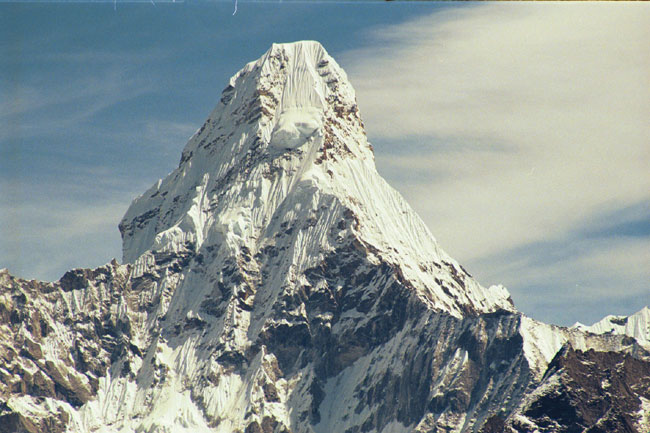
"I wanted to live in a SPACE,
that had not been shaped
by people.
Where no one
had POWER over me.
This was
the MOUNTAINS." |
I am still trying to come to terms with what has happened, and how
it has changed my life. In Traum
und Wirklichkeit (German) I am trying to organize my current
thoughts. But it is difficult... |
Kurt |
Peter |
|
When Kurt died, it really hit home. With Kurt I first went to
the Karwendel, then to the Wetterstein, the Dolomites, the Kalkkoegel
and the Wilde Kaiser. We almost got blown off the Sella pass in
the Dolomites, when our little tent collapsed at night in the middle
of a wild summer-thunderstorm. We went skiing together on his 30th
birthday, and together we almost slid over slick, ice-covered rocks
on top of the Luesener Villerspitz.
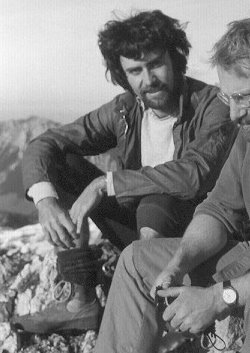
The day that Kurt and Hans were climbing the "Erdenkäufer" on the Schüsselrak, Jan and I were trying the Gonzen East face, the highest rock wall in eastern Switzerland. Ironically, the wood was so dense that we got lost on the way to the base of the climb. When we got there it was too late in the day, so we went to the Waalensee, where we climbed an incredibely steep multi-pitch climb above the lake, enjoying the first heat of the summer. When we drove home, in high spirits Kurt and Hans were already dead, just 100 miles further east. Probably Hans got pulled off balance from some snow that was choked in a crack and came loose when he climbed over it. He had no chance to survive the 25m fall. Kurt, who was belaying him, was looking up what's happening, when a rock from that falling debris ricocheted from the rock wall, tore open his jugular, and smashed his rib cage. The sulfuric smell that is often caused by splittering rocks slowly drifted away. Then everything was quiet.
Kurt died on 4. Juni 2000. He was climbing a lot with Hans Salcher, and Hans' sun put up In
memoriam Hans Salcher, which fascinatingly documents the fascination that the mountains had on Hans.. |
It has been two years since I picked up the phone, and heard Jean's voice drowning in tears. " ... is dead!!" Was all that I could understand at first. Tears - sobbing - "Peter is dead!" - tears ...
At first I did not get it at all. I wasn't climbing any more. And none of my good friends ...
then it came to me. Peter. Peter Reither. Our common friend, by partner for skiing, biking, delicious food. OK, Peter liked the outdoors, liked to go skitouring. A few years ago he also started sportsclimbing. "I don't do such crazy things as you!" he had told me ....
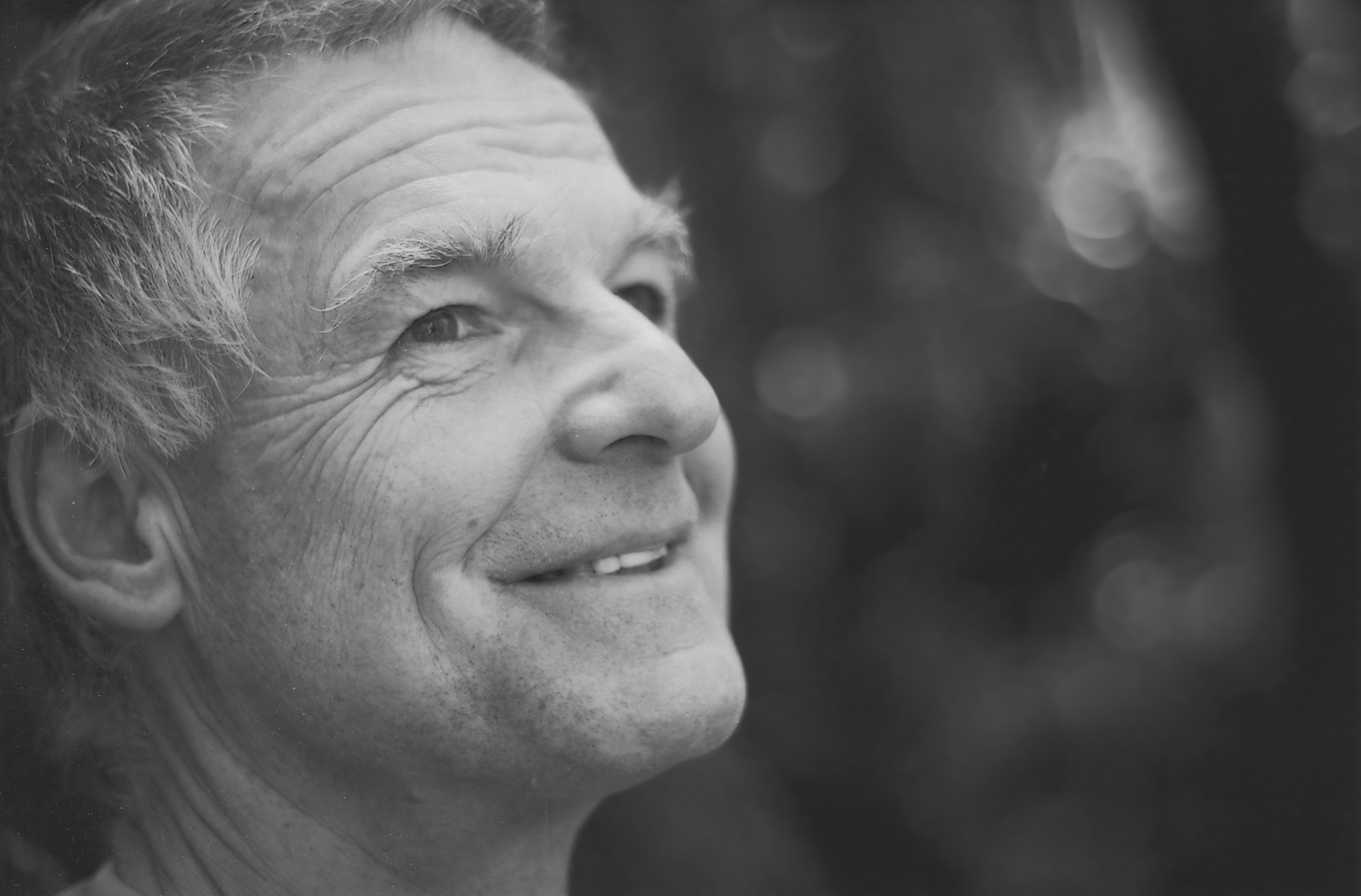
At his funeral I though: Why Peter? It would have been so much better if my fucking accident would have been "proper", and in return Peter would still live.
I guess the details are not very important. The final lengths of the Abram-ridge on the Piz Ciavazes, after the difficult bits of the climb are already below them. A rock comes loose -Peter looses his balance - falls about 45 feet - breaks his neck.
So death has caught up with me in Linz. I actually moved away from the mountains, to escape that. Now, every time I drive to Hinterstoder, I almost pull off at the parking lot where we always met up when we went to the mountains. When I am in Windischgarsten, I see the Hohe Nock, our last common skitour. It is about 4200 feet in altitude, which is quite a bit for me any more. But since Peter had so much energy left, he just did the last 1500 feet twice; the second time he walked up with me, slowly, supporting me "no rush, Thomas, just take your time". I made it to the top. Skiing down was almost unreal. The top layer of snow was made up of small snow crystals, which came loose when we carved over them. It felt as if we were not skiing, but flying down, the snow crystals swirling around us in the frosty winter sun. Now, when I look up, I think of that; when I look at the Schrocken, I remember the corniced ridge that we climbed one winter. When I look at the Grosse Priel, I think of him skiing down from the top; when ...
But Peter is dead.
How important does someone have to be for their death to unhinge you? Peter was a good friend, but not my closest one. Nevertheless, his accident pulled out the rug under my feet. It took me two years to catch myself. Perhaps, because he was my fourteenth friend who got killed in the mountains. Perhaps, because, I just can't escape those deadly accidents. How often do I still get nervous when the phone rings "Please, not again ..."
Climbing has not been a free lunch for me. So many friends dead. So much pain, so many medical problems in my everyday life. And still, I dream of being on the rock. Does this make any sense?
|
... and too many others
... |
|
Ulli, Harald, Stefan, Karim,
... it is hard to believe how much we have had to pay for our search
for life, for intensity.
And then there were the ones I did not know. The one who fell am
Bauernpredigtstuhl; I ran down to call a helicopter, but in the
evening news they said that he had died on the way to the hospital.
Another one was carried away while Flo and I climbed up the slabs.
He had tried to solo a climb, but was pushed off balance by a rock
that hit him.
Is it worth mentioning the ones that survived? The one woman whom
I saw repelling over the end of the rope in the Schuesselkar, who
had to walk back for an hour with a smashed chest, as it was too
dark for a helicopter? The man in the Dolomites who tried to hold
onto the rope with his teeth, only to find that the teeth could
not hold his weight, and came out? Or the one who unclipped the
lowest bolt during his fall in El Dorado Canyon, for whom I got
the rescue team, but who came away almost unharmed? |
|
Robert - My
Accident - Kurt - Peter - Too many others
|